If your job search lost momentum somewhere along the way, it doesn’t mean you have to start again from zero. A paused search isn’t a failed one. The groundwork you laid, the conversations you had, and the clarity you built about what you are looking for are all still there. Instead of a full restart, you need a focused re-entry that builds on what already exists rather than abandoning it. This article gives you a practical framework for doing exactly that.
Why Restarting Is Easier Than Starting Over
Starting over takes time. The average duration of unemployment currently sits at nearly 24 weeks, according to the Bureau of Labor Statistics.1 This period includes building your materials from scratch, figuring out your target, and starting conversations with people who don’t know what you’re looking for yet.
When you reactivate a paused search, most of that work is already done. Your resume exists, your target role categories are defined, and your recruiter already knows your background. The relationships you built during the first round of your search are warm.
What a reactivation requires is calibration. Over time, the market has shifted and maybe even your priorities have evolved. Some of what you tried the first time worked and some of it didn’t. Addressing those specific gaps is a much smaller lift than building everything from the beginning. It also positions you to move faster and with more focus than your original search allowed.
When you restart your search, you’ll also have clearer criteria for what you want based on what you learned the first time around, and a more realistic picture of the market than you had when you started.
The Audit: What Worked, What Didn’t, and What Changed
Before you re-engage anyone or update anything, spend time looking honestly at how your previous search unfolded. This doesn’t need to be a lengthy exercise, but it does need to be specific. A clear-eyed audit is what separates a focused reactivation from repeating the same patterns that caused the search to stall in the first place.
Work through these questions before moving forward:
- What generated real traction?
Think about the conversations, applications, or outreach efforts that actually led somewhere. Identify what those had in common. That’s where your energy should go first.
- What produced nothing?
This may range from applications that disappeared into silence to networking efforts that went nowhere. These are worth identifying so you don’t default back to them out of habit. If something didn’t work the first time, reactivating it unchanged is unlikely to produce a different result.
- What has changed since you paused?
Your circumstances, your priorities, and the market itself may all look different now. Have your compensation expectations shifted? Has your sense of the environments you thrive in gotten clearer? Are there role types you ruled out before that now feel more relevant?
Answering these questions honestly gives you an updated foundation to work from.
Read more: How to Navigate a Career Transition Successfully
Start Warm: A Focused Reactivation Plan
Your existing relationships are your fastest path back into active conversations. Start there before launching any new outreach.
Step 1: Re-engage your recruiter first.
Your recruiter already knows your background, your goals, and the kinds of roles that are likely to be a strong fit. A brief message letting them know you are actively looking again is enough to restart that conversation. With the right partner, you don’t need to re-explain everything. The continuity is already built in.
Step 2: Reconnect with your warmest professional contacts.
Identify two or three people in your network who were genuinely supportive during your previous search and reach out with a short and direct message. Let them know you’re looking again and be specific about what you’re targeting. A focused ask is far easier to act on than a general one.
Step 3: Set a realistic weekly activity target.
Decide upfront how much time you can realistically dedicate to your search each week and what that time will be spent on. Consistency matters more than intensity. A search that moves steadily at a manageable pace is more likely to reach a good outcome than one that starts with a burst of effort and fades again.
Step 4: Prioritize depth over volume.
The instinct when reactivating is to cast a wide net quickly. Resist it. A smaller number of well-targeted applications and conversations will produce better results than a high-volume approach that generates little traction. Use the audit to direct your energy toward the channels and role types that already worked in your favor.
Step 5: Give yourself a timeline.
Set a realistic endpoint for your reactivation phase. For example, choose a date by which you want to have re-engaged your recruiter, updated your materials, and have at least one or two active conversations underway. A defined timeline creates accountability without pressure and keeps the search from drifting into another extended pause.
Use a checklist to hold yourself accountable through the process.
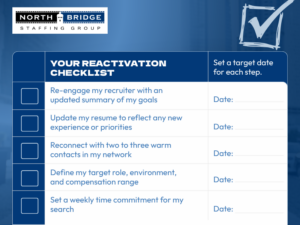
Regain momentum in your job search.
North Bridge places candidates in contract, contract-to-hire, and direct hire roles across professional services in the US and UK. When you re-engage with us, you’re not starting cold; the context we built together carries forward. Whether you’re reactivating a search or starting one for the first time, reach out today and let’s pick up the conversation.
Reference
- “Table A-12. Unemployed People by Duration of Unemployment.” U.S. Bureau of Labor Statistics, 2 Jul. 2026, www.bls.gov/news.release/empsit.t12.htm.